When sourcing custom leather labels for apparel, one of the first decisions buyers face is choosing between genuine leather and PU leather. Both materials are widely used for jeans, jackets, hats, bags, and footwear, yet they differ significantly in manufacturing methods, appearance, durability, cost, and long-term performance.
In this guide, we'll compare genuine leather and PU leather labels from a manufacturer's perspective. You'll learn how each material is produced, how they perform with different logo techniques, how they compare in durability and cost, and which option is best suited for different clothing and accessory applications.
Genuine Leather Labels
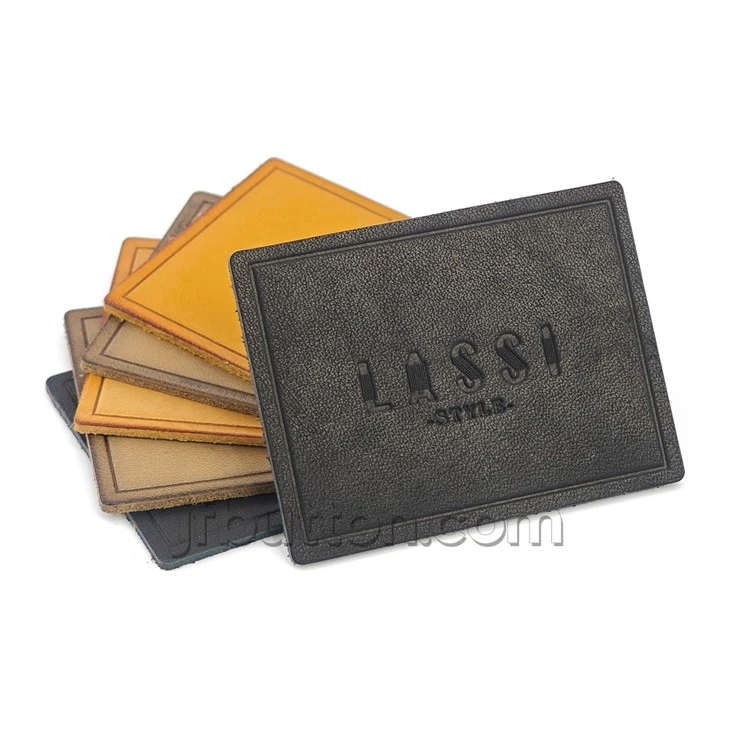
Genuine leather labels are branding patches made from natural animal hides that have been processed through tanning, dyeing, and finishing to create durable materials suitable for apparel and accessories. Unlike synthetic alternatives, genuine leather retains its natural grain, texture, and unique surface characteristics, making every label slightly different.
For custom leather labels, manufacturers typically process genuine leather into sheets before applying logos through embossing, debossing, laser engraving, or foil stamping. The labels are then die-cut into custom shapes and prepared with sewing holes or other attachment options according to customer requirements.
Common Types of Genuine Leather Used for Labels
|
Leather Type |
Characteristics |
Typical Applications |
|
Full-Grain Leather |
Highest quality, retains natural grain, excellent durability |
Luxury apparel, premium denim, leather goods |
|
Top-Grain Leather |
Smooth surface with refined finish |
Fashion garments, handbags |
|
Split Leather |
More economical with a uniform surface |
Casual apparel, promotional products |
|
Cowhide Leather |
Strong, durable, widely used |
Jeans, jackets, bags |
|
Sheepskin Leather |
Soft, lightweight, fine texture |
Fashion accessories, premium clothing |
How Genuine Leather Labels Are Manufactured
Step 1 – Selecting High-Quality Raw Leather
Every premium leather label starts with carefully selected raw hides. The quality of the finished label depends largely on the condition of the leather before production begins.
We typically evaluate:
Grain quality
Surface smoothness
Thickness consistency
Natural defects such as scars or wrinkles
Color uniformity
Depending on your budget and product positioning, different leather grades-such as full-grain, top-grain, or split leather-may be selected.
Step 2 – Tanning the Leather
Fresh animal hides cannot be used directly in manufacturing. They must first undergo a tanning process to improve durability, flexibility, and resistance to moisture and bacteria.
The two most common tanning methods are:
Vegetable Tanning
Vegetable tanning uses natural plant extracts to preserve the leather.
Chrome Tanning
Chrome tanning uses mineral salts to speed up production.
The choice of tanning method influences both the appearance and performance of the finished leather label.
Step 3 – Dyeing and Surface Finishing
After tanning, the leather is dyed to achieve the required color.
We can produce leather labels in a wide range of shades, from classic brown and black to custom Pantone-inspired colors.
Depending on your design requirements, we can also create matte, glossy, distressed, or vintage-style finishes.
Step 4 – Conditioning and Thickness Calibration
Natural leather often varies slightly in thickness. Before logo production begins, we calibrate and condition the material to improve consistency.
This process may include:
Splitting leather to the required thickness
Moisture conditioning
Surface flattening
Quality grading
Step 5 – Creating the Brand Logo
Once the leather is properly prepared, the customer's logo is applied using the selected decoration process.
The most common techniques include:
Embossing
Debossing
Laser engraving
Foil stamping
Screen printing
The choice of logo process depends on the artwork, leather type, and desired visual effect.
For genuine leather, embossing and debossing remain the most popular options because they create a premium three-dimensional appearance while preserving the natural beauty of the material.
Step 6 – Precision Die Cutting
After logo production, the leather sheets are cut into their final shape using precision steel dies or CNC cutting equipment.
We can produce a wide variety of custom shapes, including:
Rectangle
Square
Round
Oval
Shield
Hexagon
Custom die-cut designs
Accurate cutting ensures every label maintains consistent dimensions and clean edges throughout the production batch.
Step 7 – Punching Holes and Edge Finishing
If the labels will be sewn onto garments, stitching holes are punched according to the customer's specifications.
These finishing details improve both the appearance and functionality of the leather labels.
Step 8 – Quality Inspection
Before packaging, every production batch undergoes comprehensive quality inspection.
Professional manufacturers typically check:
Leather quality
Color consistency
Logo clarity and depth
Dimensions and thickness
Cutting accuracy
Hole positioning
Surface cleanliness
Overall craftsmanship
Only products that meet the required quality standards proceed to packaging and shipment.


PU Leather Labels
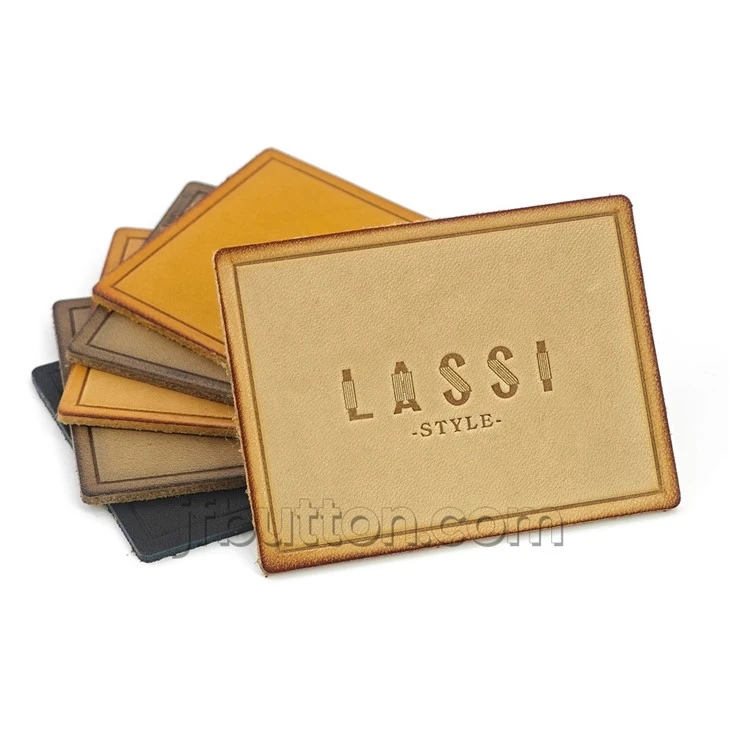
PU leather labels are custom branding patches made from synthetic materials coated with polyurethane (PU) to replicate the appearance and texture of natural leather. Designed to provide a balance between aesthetics, durability, and affordability, PU leather has become one of the most widely used materials for custom apparel labels.
Modern PU leather is available in a wide variety of finishes, including smooth, matte, glossy, vintage, distressed, and embossed textures. It can also be produced in almost any color, giving fashion brands greater design flexibility.
PU Leather vs PVC Leather
|
Feature |
PU Leather |
PVC Leather |
|
Surface Feel |
Soft and flexible |
Firmer and less flexible |
|
Appearance |
More similar to genuine leather |
More artificial-looking |
|
Breathability |
Better |
Lower |
|
Environmental Impact |
Generally considered a lower-impact option than PVC |
Less environmentally friendly due to PVC composition |
|
Fashion Applications |
Premium apparel, labels, accessories |
Budget products and industrial applications |
How PU Leather Labels Are Manufactured
Step 1 – Preparing the Base Material
The manufacturing process begins with selecting a suitable base fabric, which provides the strength and stability of the finished PU leather.
Common base materials include:
Polyester fabric
Microfiber fabric
Cotton fabric
Non-woven fabric
Step 2 – Applying the Polyurethane Coating
Once the base fabric is prepared, multiple layers of polyurethane resin are applied to create the leather-like surface.
The coating process determines many of the material's final characteristics, including:
Surface softness
Flexibility
Thickness
Durability
Color uniformity
Modern coating equipment allows manufacturers to precisely control coating thickness, ensuring every sheet meets the required specifications.
Step 3 – Creating the Leather Texture
After the polyurethane coating has partially cured, the material passes through embossing rollers that imprint a leather-like grain onto the surface.
Manufacturers can reproduce a wide variety of textures, including:
Smooth leather
Pebble grain
Saffiano texture
Lychee grain
Vintage leather
Matte finish
Distressed leather
Because the texture is created using precision embossing rollers, every production batch maintains a highly uniform appearance.
Step 4 – Coloring and Surface Finishing
Once the desired texture has been created, additional finishing treatments are applied to enhance both appearance and performance.
Depending on customer requirements, manufacturers can provide:
Matte finishes
Gloss finishes
Soft-touch coatings
Anti-scratch coatings
Water-resistant finishes
UV-resistant coatings
Unlike genuine leather, which is limited by natural hide coloration, PU leather can be produced in virtually any color, allowing manufacturers to match brand-specific color requirements more accurately.
Step 5 – Applying the Custom Logo
After the PU leather sheets are completed, custom branding is added using the customer's preferred logo technology.
Common options include:
Embossing
Debossing
Laser engraving
Foil stamping
Screen printing
UV printing
Because PU leather has a smooth and uniform surface, it performs particularly well with laser engraving, foil stamping, and printed graphics.
Complex logos, small text, and intricate patterns can often be reproduced with greater precision than on natural leather.
Step 6 – Precision Die Cutting
Following logo application, the material is cut into the required shapes using precision steel dies or automated cutting equipment.
Kunshuo can produce:
Rectangle labels
Round patches
Oval labels
Shield shapes
Hexagonal designs
Custom die-cut logos
Automated cutting ensures excellent dimensional consistency while minimizing production waste.
Step 7 – Adding Backing and Finishing Options
Before quality inspection, the leather labels are prepared according to the customer's installation requirements.
Optional finishing services include:
Sew-on holes
Iron-on adhesive backing
Pressure-sensitive adhesive
Folded edges
Rounded corners
Decorative stitching preparation
These finishing options help simplify garment assembly while improving the final appearance of the product.
Step 8 – Quality Inspection and Packaging
Every production batch undergoes comprehensive inspection before shipment.
Manufacturers typically verify:
Surface quality
Color consistency
Logo accuracy
Material thickness
Cutting precision
Edge quality
Adhesion performance
Packaging condition
Because PU leather is manufactured under highly controlled conditions, inspection standards are generally easier to maintain, resulting in excellent batch-to-batch consistency.


Manufacturing Differences Between Genuine Leather and PU Leather
|
Comparison Factor |
Genuine Leather Labels |
PU Leather Labels |
|
Raw Material |
Natural animal hides (cowhide, sheepskin, etc.) |
Polyurethane (PU) coating on a fabric base such as polyester or microfiber |
|
Material Source |
Natural and organic |
Synthetic and engineered |
|
Manufacturing Process |
Leather selection → Tanning → Dyeing → Conditioning → Logo processing → Die cutting |
Base fabric preparation → PU coating → Texture embossing → Surface finishing → Logo processing → Die cutting |
|
Production Complexity |
High, with multiple manual processing steps |
Moderate, highly standardized and automated |
|
Production Time |
Longer due to tanning and natural leather processing |
Shorter with continuous industrial production |
|
Thickness Consistency |
May vary slightly because leather is a natural material |
Highly consistent across every production batch |
|
Color Consistency |
Minor natural color variations are common |
Excellent color uniformity and easy Pantone matching |
|
Surface Texture |
Unique natural grain; every piece is slightly different |
Consistent embossed grain with customizable textures |
|
Logo Performance |
Excellent for embossing and debossing; natural texture enhances depth |
Excellent for laser engraving, foil stamping, and printing; fine details are easier to reproduce |
|
Customization Flexibility |
Moderate; limited by natural leather characteristics |
High; available in various colors, textures, thicknesses, and finishes |
|
Material Utilization |
Lower due to natural defects and irregular hide shapes |
Higher due to uniform sheet production and optimized cutting layouts |
|
Quality Consistency |
Requires careful manual grading and inspection |
Easier to maintain stable quality through automated production |
|
Water Resistance |
Moderate; often requires additional protective treatment |
Good; polyurethane coating naturally resists moisture |
|
Maintenance |
Requires proper care to preserve its appearance |
Easy to clean and maintain |
|
Manufacturing Cost |
Higher due to material cost and labor-intensive processing |
Lower, making it suitable for cost-sensitive projects |
Choosing between genuine leather and PU leather labels isn't about determining which material is universally better-it's about selecting the option that best aligns with your brand identity, product requirements, and manufacturing goals.
By understanding the manufacturing differences, material characteristics, logo compatibility, and application scenarios of each option, you can make more informed sourcing decisions and create leather labels that enhance both product quality and brand value.
Whether you're looking for genuine leather labels, PU leather labels, or need expert advice on choosing the right material, our team is here to help.
We offer:
OEM & ODM custom manufacturing
Genuine leather, PU leather, microfiber, and recycled leather options
Custom sizes, shapes, colors, and logo techniques
Fast sampling and stable mass production
Strict quality control and global shipping support
Contact us today to discuss your project or request a free quotation. Our specialists will help you select the best leather label solution for your brand and ensure your products stand out in a competitive market.
FAQ
Q: 1. Which is better for clothing labels: genuine leather or PU leather?
A: It depends on your brand positioning. Genuine leather offers a premium, natural look, while PU leather provides greater consistency and lower production costs.
Q: 2. Is genuine leather more durable than PU leather?
A: Yes. Genuine leather generally has a longer lifespan and develops a natural patina over time. High-quality PU leather is also durable but does not age in the same way.
Q: 3. Can both genuine leather and PU leather be embossed?
A: Yes. Both materials support embossing and debossing, although genuine leather typically produces a deeper and more natural textured effect.
Q: 4. Which material is better for laser engraving?
A: PU leather is usually better for laser engraving because its uniform surface allows finer details and cleaner lines.
Q: 5. Which material is more affordable?
A: PU leather is more cost-effective and is commonly used for large-volume apparel production.
Q: 6. Are PU leather labels waterproof?
A: PU leather has good moisture resistance, making it suitable for everyday apparel and accessories. However, prolonged exposure to water should still be avoided.
Q: 7. Can I customize the color and texture of both materials?
A: Yes. Both materials can be customized, but PU leather offers a wider range of colors, textures, and finishes with greater consistency.
Q: 8. Which material is better for premium denim brands?
A: Genuine leather is the preferred choice for premium denim because of its authentic texture, durability, and timeless appearance.
Q: 9. What logo techniques are available for leather labels?
A: Common options include embossing, debossing, laser engraving, foil stamping, screen printing, and UV printing, depending on the material and design.
Q: 10. Which material is more suitable for large-scale production?
A: PU leather is ideal for mass production because it offers stable quality, consistent dimensions, and efficient manufacturing.
Q: 11. How do I choose the right material for my brand?
A: Consider your budget, target market, product category, branding style, and durability requirements. A professional manufacturer can recommend the most suitable option.